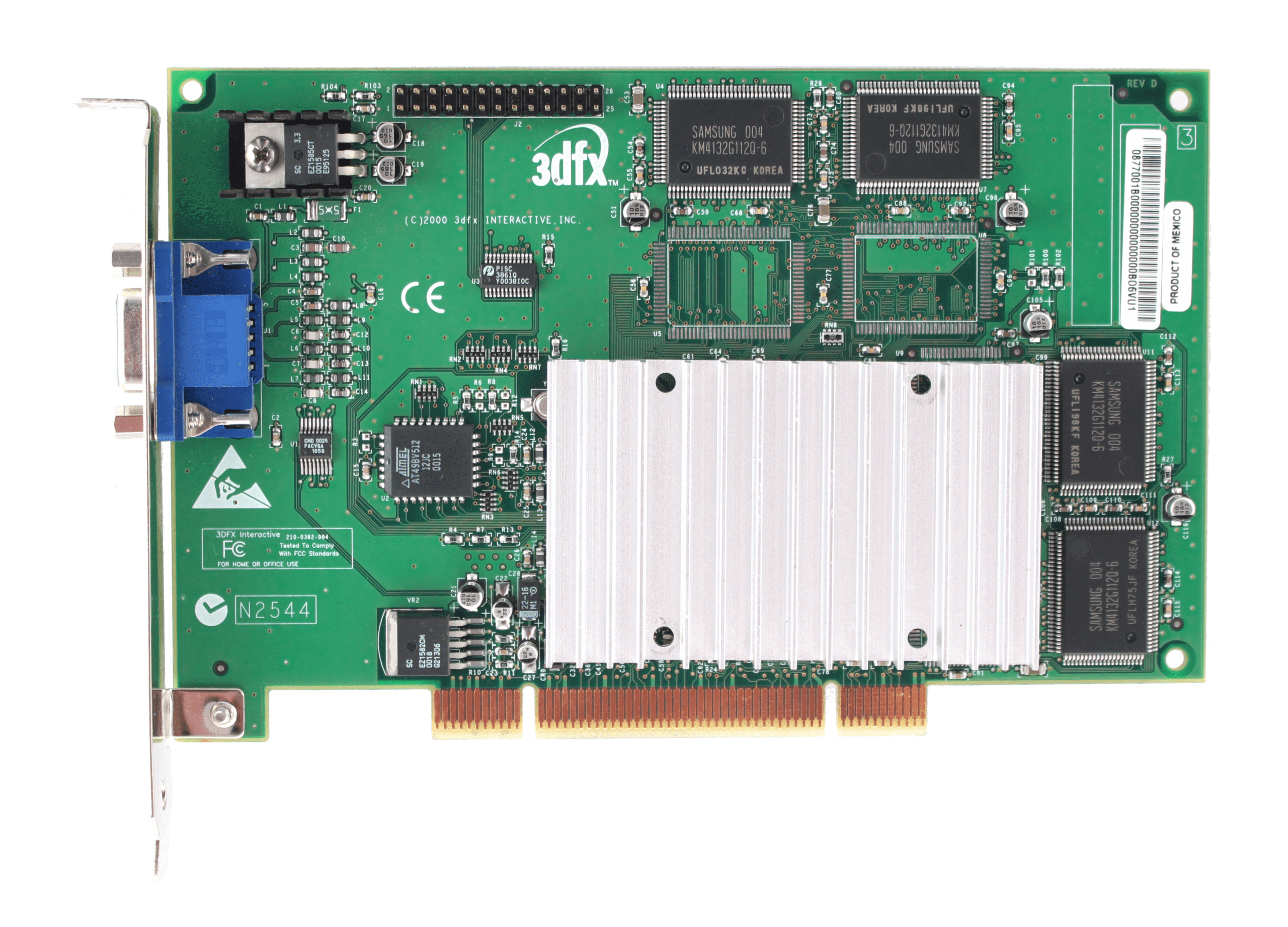
AGP Graphics Card3dfx Interactive
3dfx Voodoo3 3000 AGP
3dfx Interactive · 1999 · AGP Graphics Card
3dfx's last great card before the wheels came off.
About This Hardware
The Voodoo3 3000 is the middle card in 3dfx's third-generation Voodoo lineup, positioned between the budget 2000 and the flagship 3500. Released in early 1999, it was built on 3dfx's own board manufacturing after they acquired STB Systems. It features 16MB SDRAM, a 166MHz core clock, and support for Direct3D, OpenGL (via ICD), and 3dfx's proprietary Glide API. It was widely regarded as one of the fastest consumer gaming GPUs available in mid-1999.
Specifications
| GPU | 3dfx VSA-100 (Voodoo3) |
| Memory | 16MB SDRAM |
| Core Clock | 166MHz |
| RAMDAC | 350MHz |
| Interface | AGP 2x |
| API Support | Glide 2.x/3.x, Direct3D, OpenGL (ICD) |
| Max Resolution | 2048x1536 |
| Fill Rate | 333 megatexels/sec |
| Outputs | VGA, TV/S-Video |
| OS Support | Windows 9x, Windows NT 4.0 |
Hardware Info
| Manufacturer | 3dfx |
| Category | AGP Graphics Card |
| Released | 1999 |
| MSRP | $179 (launch) |
| Street Price | Check eBay — pricing varies (not verified) |
| Reviewed | May 25, 1999 |
How to Get One Today
Price
Street price: Check eBay — pricing varies (not verified) · MSRP: $179 (launch)
Used / Collector Market
Common on eBay. Look for AGP slot boards specifically — the Voodoo3 also shipped in PCI. Cards are generally reliable but are 25+ years old, so inspect seller photos for capacitor condition and confirm the heatsink is intact. AGP versions command a slight premium over PCI.
Notes & Warnings
Confirm you are buying AGP and not PCI — both exist and look nearly identical in photos. The Voodoo3 3000 does not support 32-bit color rendering or AGP texturing (DIME/DIME2). This was a known limitation at launch and remains one today. If your build requires 32-bit rendering for specific titles, look at a NVIDIA GeForce 256 or ATI Radeon instead. OpenGL ICD support requires driver version 1.04.00 or later.