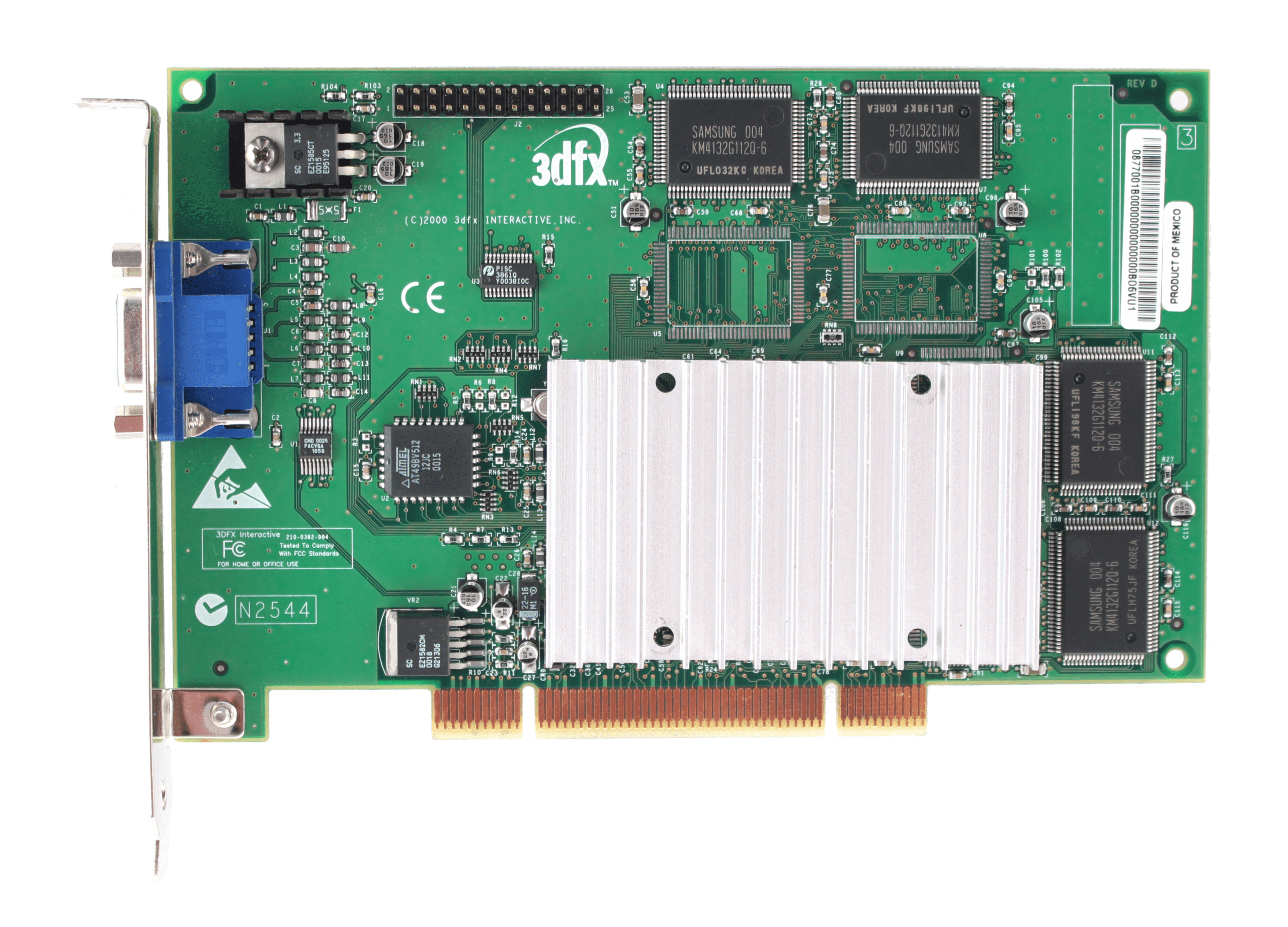
3dfx Voodoo3 3000 AGP
If you were gaming on a PC in the late 90s, the name Voodoo carried real weight. You did not need to understand why. You just knew that a Voodoo card meant your games stopped looking like someone smeared Vaseline on the monitor. The Voodoo3 3000 is the middle card in the new lineup, not the budget option, not the top of the stack, just the one most people are actually going to buy. I got one. Here is what I think.
Installation is about as painless as it gets. Pull the old card, slot this one in, install the drivers, reboot, hope Windows does not throw a tantrum today. 3dfx even put an installation video on the driver CD, which sounds unnecessary until you remember that not everyone has been elbow-deep in PC cases for years. It is a nice touch. The whole process took me a few minutes and nothing blew up.
The 2D side of this card is legitimately impressive and nobody talks about it enough. Text is sharp. Windows redraws fast. Big documents in Word and Photoshop do not make the screen feel like it is being painted by someone half asleep. That 350MHz RAMDAC is not just a spec bullet, you actually see it. Every card you compare this against that falls short on 2D quality, you notice it every second you are not in a game.
DVD playback on the monitor is clean and sharp, better than what I was running before. On a TV through the S-Video out, it is fine but not exceptional. If your whole setup is built around DVD output to a television, a dedicated decoder card still has the edge. For regular desktop DVD watching, the Voodoo3 handles it without complaint.
The games. That is why you are here. Quake II runs at over 110 frames per second at 800×600. Unreal at 1024×768 is smooth and gorgeous. Kingpin, Turok 2, Forsaken, Incoming, all of them fly. The framerates are where you want them across every resolution that matters.
Image quality is also a genuine step up from older Voodoo and Banshee cards. Colors are richer and that ugly color banding that used to show up and ruin the atmosphere is mostly gone. 3dfx uses a post-framebuffer filter that gets you to about 22-bit color even when rendering at 16-bit. People on message boards will argue about this forever because 32-bit is on the spec sheet and 22-bit is not 32-bit. Fine. In a real game running at 1024×768, I would take 22-bit smooth over 32-bit choppy every single time. Running higher resolution and higher framerates beats running a prettier screenshot for benchmarking purposes.
The complaints that keep showing up on spec comparison lists are real but mostly irrelevant right now. No 32-bit external rendering, only 16MB of RAM, no 512×512 texture support, does not use AGP texturing. On paper that sounds like a problem. In practice there is not a game on the shelves that makes any of those omissions matter. Quake III Arena is the one people keep pointing at and 3dfx says an OpenGL ICD is coming. When that game ships and the ICD lands, this card will run it fine.
The Voodoo3 3000 is not hedging its bets on the future. It is built for right now, and right now it is one of the fastest gaming cards you can buy. If you need the spec sheet to have every checkbox ticked for hardware you will not use for two years, look elsewhere. If you want to actually play games today and have them look and run great, this is the card.
I have no regrets. None.
The Voodoo3 3000 is built for today's games, not tomorrow's arguments. Fast, clean, and easy to recommend.
Requires an AGP slot motherboard (AGP 2x or 4x). Compatible with Windows 95, 98, and NT 4.0. Install the 3dfx reference drivers from the CD or download updated drivers from 3dfx.com. For OpenGL support in Quake III and similar titles, driver version 1.04.00 or later is required.
No re-releases or modern equivalents. This is a period-correct piece of hardware.
Available on eBay. Confirm you are buying an AGP card and not a PCI version — both exist and photos are not always clear. Pair with a Pentium II or III system and 128MB of PC100 SDRAM for the authentic experience.
The Voodoo3 3000 also shipped in a PCI version for systems without AGP. Performance is nearly identical. If your vintage build lacks an AGP slot, the PCI version is a direct substitute.