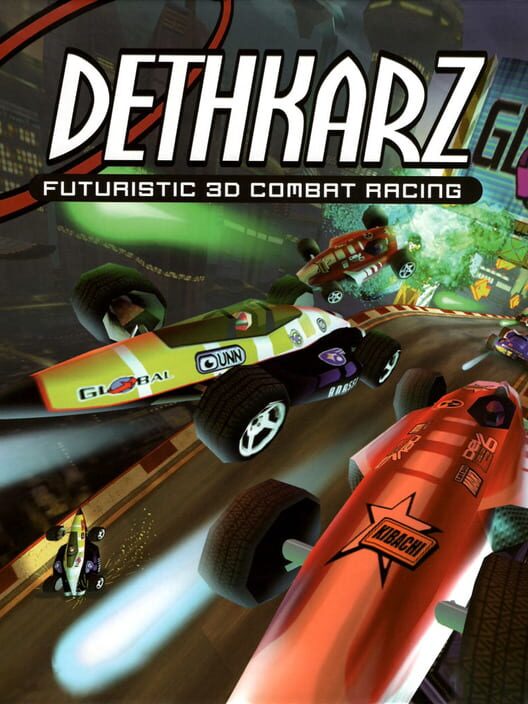
DethKarz
I wanted to love DethKarz. Futuristic racing, weapons, a year set so far ahead (2408) that anything goes — on paper that is exactly the game I wanted on my hard drive in 1998. Melbourne House had the pedigree. Beam Software built it. And when you first boot it up and see what those Voodoo cards can do with neon-lit tracks hanging in the sky, you think you are about to get something special.
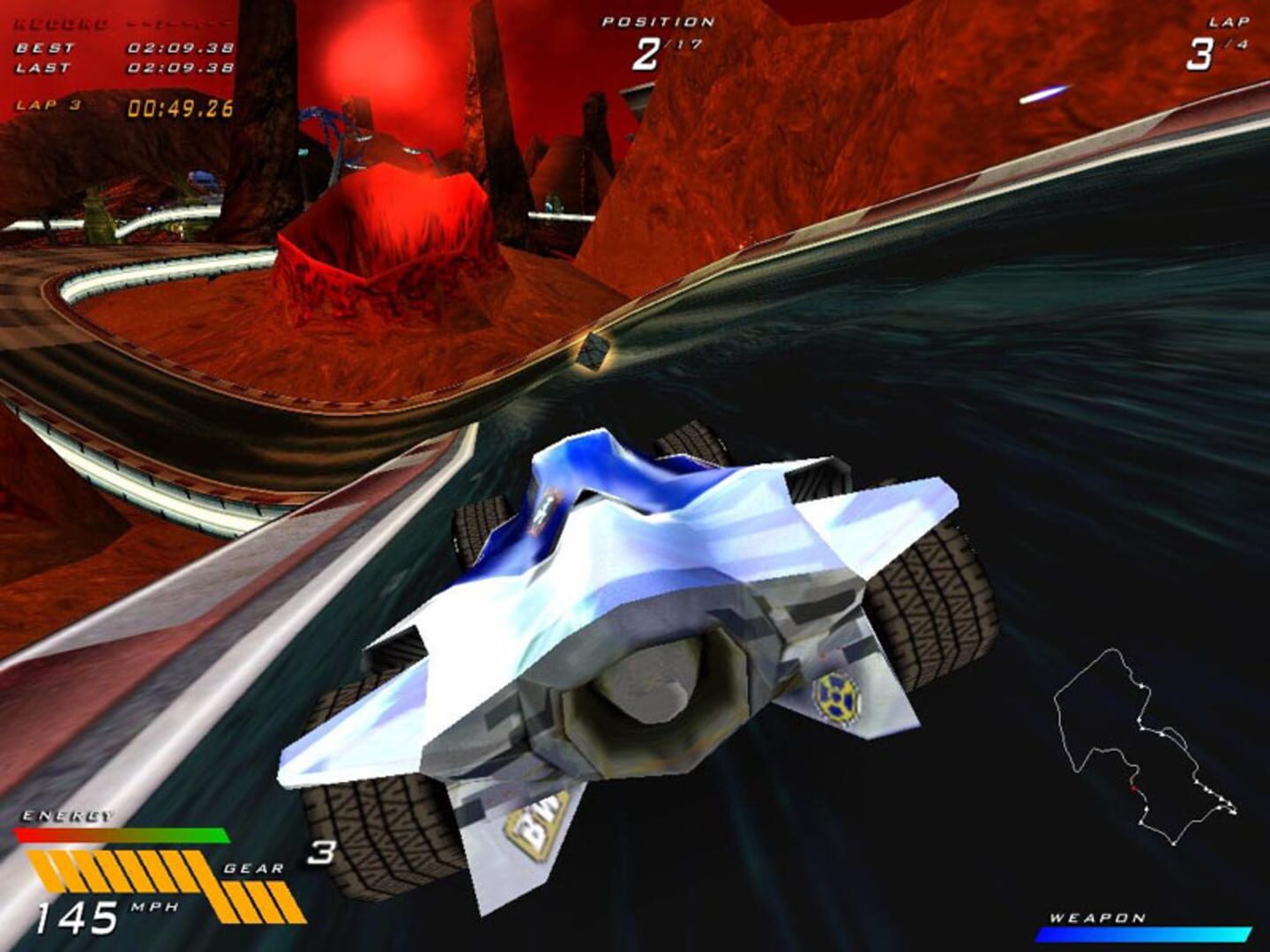
The speed is real. DethKarz is genuinely, unapologetically fast, and the tracks give it room to breathe — four environments (Metro City, Grand Keys, The Pole, Red Planet, each in three length cuts) with enough variety that you are not staring at the same textures all night. The combat layer works: missiles, mines, guided warheads, a cluster bomb that scatters across the track like a bad idea. Weapons pickups are placed where they create friction, not just where they are convenient. Blasting a rival off an elevated section and watching the recovery aircraft fish them back onto the circuit never gets old, at least for the first few hours.
The visuals were the talk of the genre in 1998 and I can see why. Beam Software built this thing specifically to push 3Dfx hardware, and if you had a Voodoo 2 (or even a Banshee), DethKarz repaid the investment. Reflective surfaces, lighting that actually does something, tracks that glow. It looks like what the future was supposed to look like.
Here is where I have to be honest. The handling will eat you alive if you let it.
These cars do not grip. They float and slide and want nothing to do with the concept of traction, which on the elevated, rail-free tracks means a missed corner sends you off the edge more often than you would like. The recovery mechanic drops you back on the circuit at half speed, which means a single error in a tight race is effectively a DNF. The learning curve is steep enough that the first several hours are more about not falling off than actually racing. For veterans of the genre who have put time into Wipeout XL or POD, the muscle memory adapts. For anyone coming in cold, it is punishing in ways that feel arbitrary rather than earned.
The multiplayer situation is honest: LAN only, up to eight players, IPX or TCP/IP. No online. In late 1998 that was a reasonable limitation and at least it works cleanly when you have the network for it. Eight players on these tracks is chaotic in a way the single-player mode never quite matches.
The problem DethKarz cannot escape is that it does everything the genre already does, and does most of it slightly worse than the competition. Wipeout XL is faster and better to handle. POD has a more interesting weapon economy. DethKarz brings strong visuals and solid production, but nothing that redraws the map. The consensus at the time called it a decent racer that could not match NFS3 or Test Drive 5, and that reads right to me.
DethKarz is the kind of game you show someone to prove what a Voodoo card can do, then quietly shelve once Wipeout XL is back in the drive. The speed is there. The combat works. The controls will make you want to throw the keyboard. Worth a few hours if the genre is your thing and the GOG price is right -- just do not expect it to displace anything you already love.
You need a Windows 9x machine with a 3D accelerator to run the retail disc properly. The game was built for 3Dfx Glide, and a Voodoo 2 or Voodoo Banshee is what it was designed around. Original CDs turn up on eBay regularly and cheaply. If you are running period hardware, this is the version to track down.
Piko Interactive put DethKarz on GOG.com in December 2019. It is a few dollars, DRM-free, and runs on Windows 10 and 11 via the bundled nGlide wrapper. One known issue: the in-race music plays once and stops rather than looping. A community mod exists that extends the music files if that bothers you.
The GOG release is the practical choice for anyone without period hardware. Install nGlide (bundled), set it to your resolution, and it runs. The retail disc on a modern machine needs nGlide manually -- grab it from zeckensack.de and point it at the game executable. No DOSBox needed; this is a native Win32 title.
No console ports were released. A Nintendo 64 version was planned but cancelled before it shipped. Streaming and cloud gaming options are not available as of this writing.
| Platform | Windows 95/98 |
| Released | 1998 |
| Developer | Beam Software |
| Publisher | Melbourne House |
| Genre | Car Combat, Racing |
| Reviewed | March 1, 1999 |