The Man Who Called It Ancient
Jim Ryan retired from PlayStation in 2024. The disc's end date was signed in 2026. Both facts are true, and the second one is his.
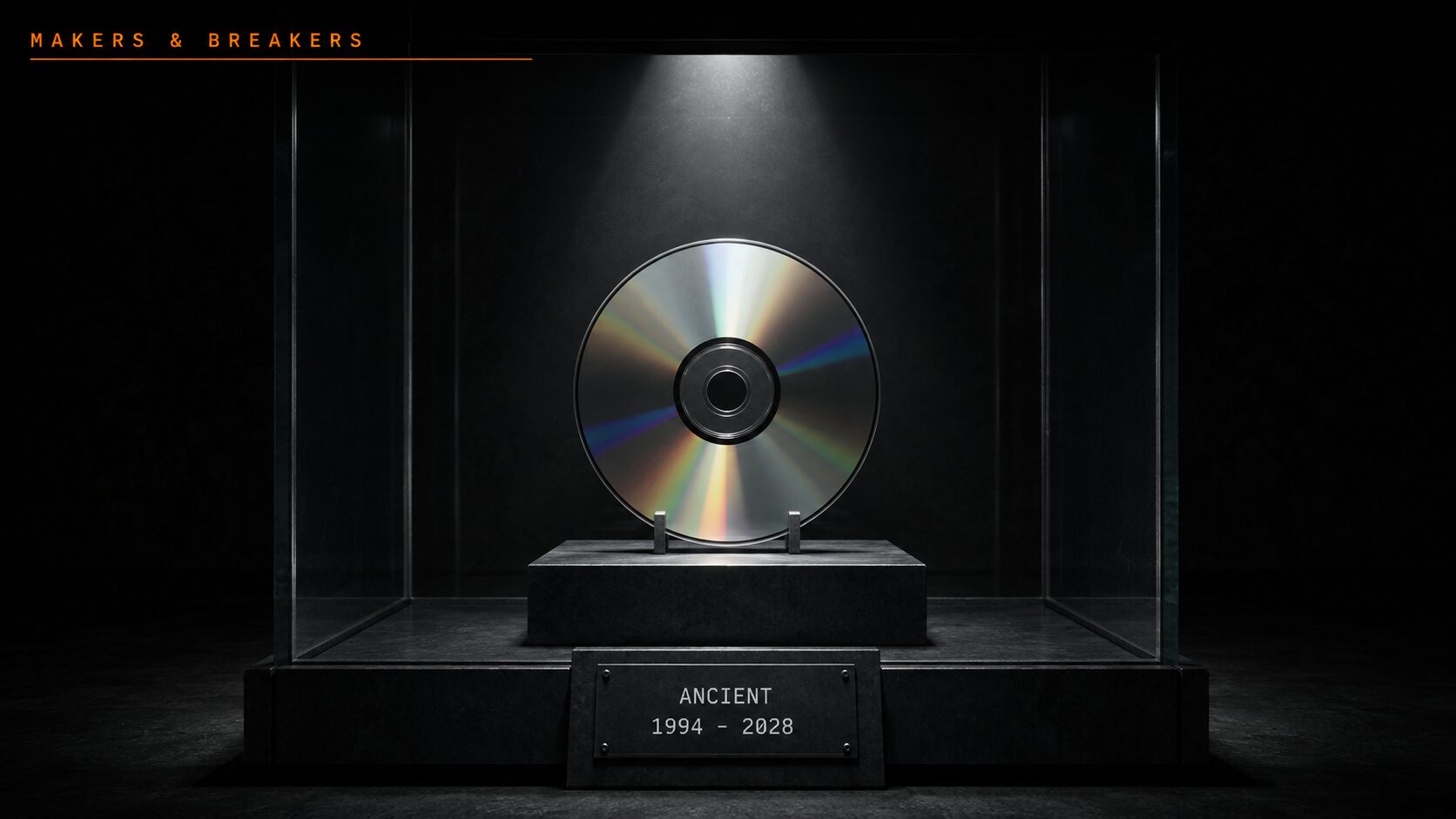
Looked ancient, like why would anybody play this?Jim Ryan, 2017
Jim Ryan retired from PlayStation in March 2024. This week, more than two years later, Sony announced it will stop making game discs for new PlayStation releases starting in January 2028. Those two sentences look unrelated. They are not. The second one is the first one finishing its work.
Let me be clear about what I am saying and what I am not. Ryan did not sign this week’s announcement. He was long gone when it went up on the PlayStation Blog under someone else’s name, and he did not set the 2028 date. He did not push the button. What I am going to argue is that the button was wired years ago, by him, and this week somebody just leaned on it.
The quote he never lived down
It all started in 2017. Jim Ryan sat down with TIME magazine and described a moment that was meant to be a brag. He had seen the Gran Turismo games running next to each other, PS1 through PS4, one racing series lined up across four generations. Looking at the old ones, he said the PS1 and PS2 versions “looked ancient, like why would anybody play this?”
He spent years trying to walk this back. He said, more than once, that he was not trying to be disrespectful to the heritage, that the point was how far the series had come, that it came out wrong. I believe him. Things come out wrong. But there is often some truth to the things we say before we think about them. You do not accidentally call your own company’s history ancient unless, somewhere underneath, that is how the history registers to you: as the old version, the thing the new version improved on, the thing nobody sane would go back to.
That reflex is the whole story. Hold onto it.
What finite means
Ask why the PlayStation 5 isn’t like the Xbox Series X, which has a larger amount of backward compatibility, and you get, eventually, to Ryan’s own defense of it. Time, engineering resource, and money are all finite, he said, and important trade-offs have to be made about what gets included and what does not. It is a reasonable sentence. It is also a choice.
Here is the trade-off Sony made. The PS5 plays PS4 games natively and mostly stops there. So your PS3, PS2, and PS1 libraries do not come along for free; the fraction you can play arrives through a paid subscription tier, streamed or re-packaged, rented back to you. Meanwhile, over at Xbox, the same era of hardware plays games from every prior Xbox generation, discs included, because someone there decided backward compatibility was worth the finite time and money. They made different choices. Ryan’s PlayStation chose forward.
Forward is a strategy, and for a while it was a spectacularly successful one. He took over global PlayStation in 2019, launched the PS5 into a pandemic, and still moved the thing by the tens of millions. Nobody gets to call that a failure. But under Ryan, PlayStation treated the past as something to outrun, not something to carry forward.
The account balance
The PS5 shipped in 2020 in two flavors, and one of them, the Digital Edition, had no disc drive at all, sitting right there on the shelf next to its disc-drive twin, at launch, as a first-class option. By the time the Slim and the Pro came around, the drive was a separate box you bought and clipped on, and the Pro shipped with none in the carton. Standard equipment became an accessory. And then, this week, the accessory became a date on the calendar.
None of that is one man’s fault. Players walked toward digital on their own two feet, for reasons of real convenience, and by Sony’s own most recent numbers, digital hit a record 85 percent of full-game purchases on PS4 and PS5. Sony is not inventing that number. That share was nineteen percent a decade ago. The pandemic pushed it to sixty-five in 2020, and it has climbed every single year since. But when you take the disc drive out of the box and sell it separately, physical sales are going to drop. You cannot demote the format and then cite the declining numbers as justification. PlayStation fed this trend at every turn: priced it, packaged it, put the driveless box on the launch shelf, moved the back catalog behind a subscription, and told a story where the old formats were ancient and the future was an account you log into. You do not end up announcing the death of the disc unless, for years, the disc has been the thing you were quietly finished with.
And think about whose history this is. This is the company that gave us the Walkman, which put tapes in vogue. The Discman, which made the CD ubiquitous. The PS2, which was the first mass DVD player at a reasonable price. People bought the PS2 just to watch movies. The PS3 did the same for Blu-ray. Sony taught an entire generation that the disc was the future. Now it is teaching the next one that it is the past.
The console with nothing to read
Here is the part Sony did not announce, and did not have to. The PlayStation 6 almost certainly will not have a disc drive. No, no one has leaked this to me. It’s just simple math. If new games stop coming on discs in January 2028, and the next console arrives around or after that line, then a drive in the box has nothing new to read. You do not spend money putting a reader in a machine when there is nothing for it to play. The only reason left to include one is backward compatibility, letting you play the PS4 and PS5 discs you already own, and we already know exactly how much this company values letting you play the games you already own. Ryan told us in 2017. So expect the shape the analysts are circling: a digital-only base PS6, and if you are lucky, a clip-on drive sold separately for the people still clinging to a shelf like me.
Why a retro site cares who did it
You might reasonably ask why a site that focuses mostly on retro gaming cares about a corporate executive who left in 2024. Here is why. The instinct that looks at a twenty-year-old Gran Turismo and sees something ancient is the exact same instinct that stops making discs. Both come from the same place: a belief that a game is a service you are currently using, not an object you own and keep. And the disc, the dumb plastic disc, is the single strongest argument against that belief. A disc outlives the storefront. It gets lent, resold, dumped, archived, and played on a dead console twenty years after the servers go dark. A code in a box does none of that. It is a license with a shelf date, and when the listing goes, so does your access, and nobody who took your money is obligated to care.
The people whose actual job is saving games have started saying the quiet part out loud about where this road ends. Frank Cifaldi, the founder and director of the Video Game History Foundation, agreed on Bluesky that piracy is “the only extant form of media preservation that exists in games right now.” Sit with how damning that is. When the legal path to keeping a game dead-ends at a shut-down server, the one the industry calls illegal is the only one still doing the work the industry walked away from.
You do not have to take my word for how that ends, because Sony ran the experiment on the very same day. Hours after telling us the future is digital only, the company announced it is closing the PlayStation Store on the PS3 and the Vita, in phases starting this August, worldwide by the summer of 2027. Read those two announcements together and the ownership pitch collapses on contact. Digital is forever, right up until the store shuts, and then it is whatever you already downloaded and nothing else. Sony even offered the tell in its own words: you can keep re-downloading your purchases “for the foreseeable future.” Not forever. For the foreseeable future, which is a promise with a dimmer switch on it. A disc never needed that sentence.
This is not abstract for me. POCG exists because a box of Zip disks at my mom’s house survived when everything else about this site’s first run did not. The archive came back because there was a physical copy. That is not nostalgia; it is a load-bearing fact about how anything from that era reached the present at all. So when the largest console maker in the world sets a date to stop making the physical thing, the preservationist in me does not hear a convenience upgrade. He hears a door closing on the future the way one already closed on the past, and this time we get advance notice.
There is a parallel here I cannot ignore. This whole site runs on the idea that some things should not be contingent: a review should not depend on who is paying, and a game you bought should not depend on whether the company that sold it to you still feels like hosting the server. A disc and an honest review have the same virtue. They exist whether or not somebody finds it convenient.
The maker and the breaker
Makers and Breakers is supposed to be about a person and the thing they made or broke. Jim Ryan made the most commercially successful PlayStation generation in history, and that is not nothing. But he also broke something. He taught the biggest name in console gaming to stop looking back. Everything followed from that: the thin backward compatibility, the driveless console on the launch shelf, the back catalog behind a paywall, and now a January in 2028 when the disc stops being made.
He called it ancient in 2017. In 2028 the company makes it official. Between those two dates is a career, and the career is the answer to the question the disc announcement raises but does not answer, which is simply: how did we get here. We got here on a road a man built while telling us the old country it led away from was not worth the drive.
Before the countdown, though, the honest other half, because doom is lazy and this is not over. Physical game spending actually rose last year for the first time since 2009. The demand Sony is walking away from is real and it is growing, not dying. And Nintendo, by every analyst account, is not following off this cliff. Cartridges and a family audience keep physical worth making, and that is the proof that none of this was inevitable. It was a choice. Boutiques still box up collector’s editions, homebrew crews still ship brand-new games on real cartridges, and the disc is not dead yet just because the biggest company in the room decided it was finished with it.
So one piece of advice, and it is the same one this site has given for years, only now it comes with a clock. Buy physical while physical is still a thing you can buy. Everything already on a disc stays on a disc, and there are eighteen months of new releases left to press before the door closes. Use them. The advice was always right. Today it became a countdown.
- Physical disc production ending in January 2028 for new games releasing on PlayStation consoles ↗ PlayStation BlogPrimary
- An update on PlayStation Store for PS3 and PS Vita ↗ PlayStation BlogPrimary
- Sony's PlayStation boss on old games ('looked ancient') ↗ Axios
- PlayStation boss 'wasn't trying to be disrespectful to our heritage' with dismissive quote ↗ GameSpot
- Jim Ryan, President & CEO, announces retirement after 30 years with Sony Interactive Entertainment ↗ Sony Interactive EntertainmentPrimary
- Game preservation leader agrees that piracy is the only preservation option for a discless future ↗ PC Gamer