The Subsidy, Part Two: The Bill Comes Due
Two weeks ago Microsoft called Xbox a subsidy. This week we found out who pays for it.
A few weeks ago at the Xbox Games Showcase, Undead Labs revealed State of Decay 3 in motion for the first time and gave it a release window for next year. Around the same time, seventy-two minutes of raw alpha footage made its way out, a survival loop with the bugs and rough edges still showing. My friend JR, who is probably the world’s biggest State of Decay fan, was quick to share this footage on our Discord. Now it wasn’t what I would call a polished, ready-to-launch reel. But it was seventy-two minutes of a game deep enough in development that you can see how it actually plays.
Fast forward to this week and Undead Labs is on a list of studios Microsoft is trying to sell or shut before the fiscal year closes. This is the same game that was premiered on the stage at the Xbox Games Showcase. Not even a month ago. But the problem is, the game and the spreadsheet are pointing in opposite directions, and when it comes to the “new Xbox” the spreadsheet wins.
I wrote about this a couple weeks ago, in a piece I called The Subsidy. The argument was simple: when Microsoft started calling Xbox a “subsidy,” that one word meant something beyond a flippant remark in a podcast. A subsidy is something you cut. I said to watch what happens and what all that word would entail as we moved forward. I knew the end of the fiscal year was quickly approaching, but I did not expect the answer to arrive quite this fast, or this completely. So this is part two of that story, and I am sorry to say it writes itself.
What landed
The fiscal year ended on Tuesday, June 30th. The reporting that came out on Tuesday, and keeps coming right up to the day I publish this, puts the cuts exactly where many analysts thought they would be. So here is the shape of it, and I am going to keep this short because you can read the whole background in part one and I would rather spend the words on what is new.
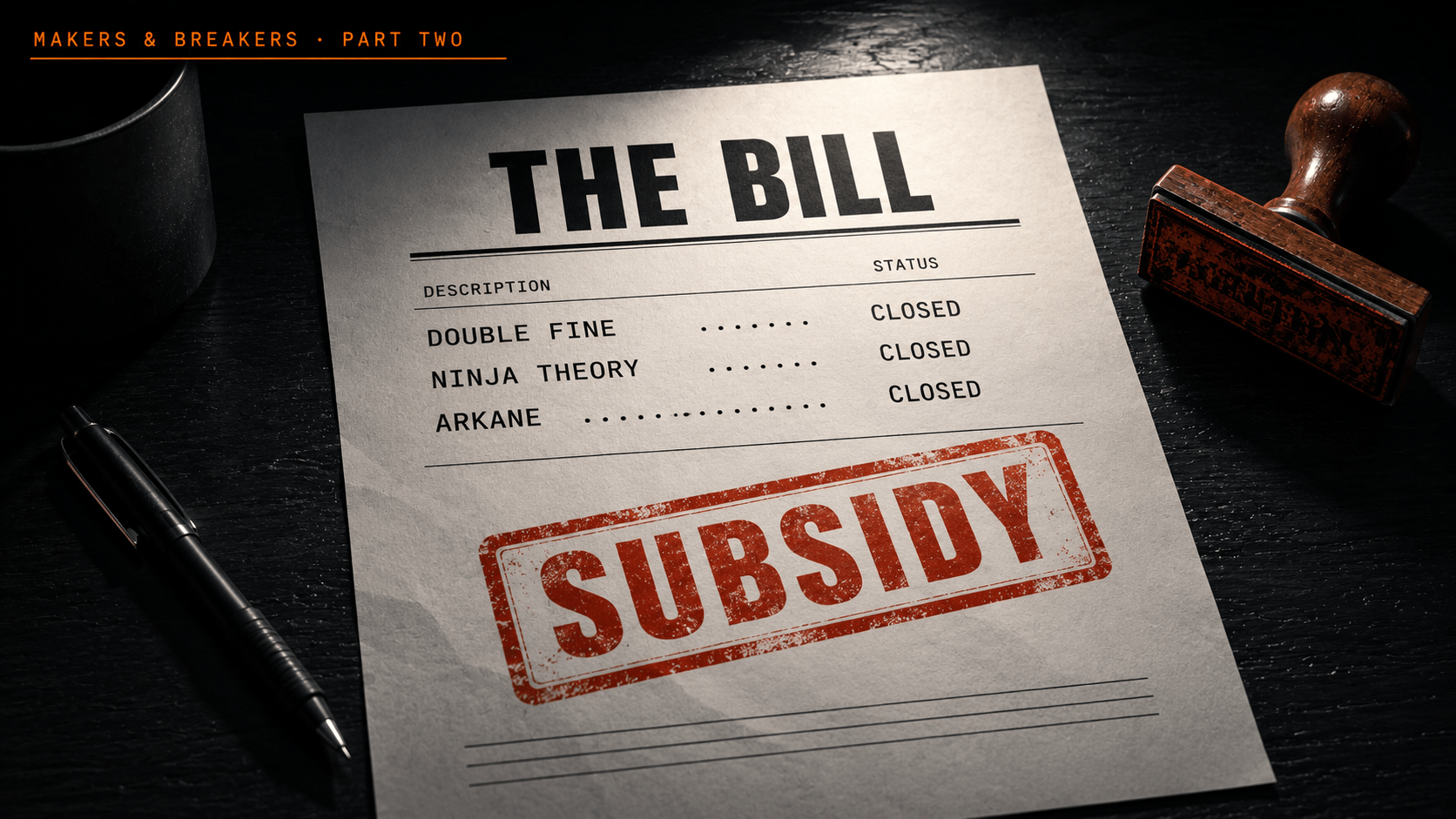
Five first-party studios are being shopped or closed: Double Fine, Compulsion, Ninja Theory, Undead Labs, and Arkane, the Dishonored studio, whose long-delayed Marvel’s Blade is reportedly being cancelled as well. In the days since I started writing this, the list only got longer. Microsoft pulled its funding from IO Interactive’s “Project Fantasy,” the online RPG from the Hitman studio. IO now has to find new money or publish it themselves, with layoffs apparently already pending. An Xbox spokesperson explained the logic to Bloomberg: the company is “focusing on our highest priorities.”
Much like the word “subsidy”, hold onto that phrase “focusing on our highest priorities.” It does more work than it looks like.
Because in the same wave of cuts, one project came through untouched. Hideo Kojima’s OD, the horror game his studio is making with Xbox publishing, is reportedly safe. I have nothing against Kojima. OD might be the most interesting thing on Microsoft’s slate. But put the two facts next to each other and “highest priorities” stops being a euphemism and starts being a sentence with a meaning. So who is Xbox’s highest priority? And who isn’t.
The makers, this time, are the credits you scroll past
So this Editorial series is called Makers and Breakers. And in part one of this series, the maker was Phil Spencer. The man who stood up on a stage in 2015 and promised your old games would keep working, he was the closest thing modern gaming had to a preservationist at that level of power. And then he was gone. The breaker was Asha Sharma, the new CEO who arrived from Instacart and Meta and announced the reset.
But it is not the people on stage who get cut. It is the names that roll up the screen after the logo. The ones who built South of Midnight, which won a Peabody. That award almost never goes to a video game. Microsoft’s own chief content officer called it a validation of what games can do. The ones who built State of Decay, and Hitman, the games Microsoft was happy to put on stage and take the applause for, weeks before deciding the people who made them were a margin problem.
On June 29 those people did something the credits-roll usually does not let them do. They spoke. More than three thousand five hundred unionized Xbox, ZeniMax, and Activision workers, organized through the CWA, held a press conference ahead of the cuts and refused to go quietly. Frank Arce, a vice president at the union, put it as plainly as anyone has put anything in this whole saga. Workers “will not be treated as disposable,” he said, and then the line that should follow Microsoft around: “The money is there. Leadership is simply choosing where it goes and who pays.”
And he is not speaking in the abstract. This is a company that spent more than eighty billion dollars on AI in the last year alone. The money is there. It is a matter of public record. What is scarce is not the cash. It is the will to spend it on the people who make the games, instead of on the machines being sold as the reason those people are expendable.
Mahreen Fatima, a senior environment artist on Diablo 4, pointed at the billions Microsoft has poured into AI and said, “They’re just choosing not to protect us.” Andrew Snell, a QA tester, was shorter: “We’re done paying for executives’ failures.”
They built two things. They built the games, and then they built the only thing in this entire story that has any power to push back. The union contracts. The press conference. The proposal they put to Microsoft and have been pushing for months: give people advance notice before you cut them, freeze hiring so the survivors can move into open roles instead of out the door, give laid-off workers two years of recall rights so a closure is not necessarily forever. Reasonable, humane, cheap. Microsoft sat on it for months and rejected it.
When a company will not even agree to warn people before it fires them, it has already told you how it files them.
Follow the money up
The money is there. Leadership is simply choosing where it goes and who pays.Frank Arce, CWA District 9
So who decided State of Decay 3 was a cost and OD was a priority? Not the person at the podium. In part one I put the reset on Sharma, and I even gave her some credit, because the business problem is genuinely real and somebody handed her this mess. But the problem isn’t just Sharma’s.
As we have now found out, the number that is closing these studios did not start with the CEO of gaming. It started in finance. The reporting points at Amy Hood, Microsoft’s chief financial officer, and a target she is said to have set for the gaming division: a thirty percent “accountability margin.” Roughly double what anyone in this industry actually makes. The games business runs in the high teens to low twenties in a good year. This is the same thing you see at other companies when they are trying to kill a division or brand. They make the goals almost unobtainable.
I have to be careful here, and I want to be, because precision is the whole point of doing this on a site like mine instead of in a comment thread. Microsoft says the thirty percent figure is incorrect. Sharma has said her mandate “is not 30% accountability margins,” it is to be the number one gaming company. Take them at their word on the exact number. It changes less than they would like. Because the framework is real and confirmed out of Sharma’s own memo: Xbox is being measured on an “accountability margin,” it will end this year around three percent, and that number is down. Whether the target on the wall reads thirty or twenty-five or fifteen, it doesn’t really matter.
And that is the real difference between part one and this one. Last time the breaker had a face. This time it is a number on a spreadsheet, set by someone who will never have to sit on the call where a studio is told it is closing.
Why a retro site keeps writing about a 2026 financial issue with Xbox
Same reason as last time, and it is worth repeating because it is easy to lose. I run a site about old games. Preservation is the job. Part one was about the obvious kind: keeping the games you already bought playable on the next box, the promise Spencer made and the people leaving took with them.
This is the other kind, and it is quieter. A game can be erased before it ever ships. State of Decay 3 has been promised for years. It is in alpha. We have seen seventy-two minutes of it. If the studio closes without a buyer, that game does not get delisted, it never exists, and you cannot back up a thing that was never released. Project Fantasy is in the same limbo. Preservation does not start at launch. It starts at the decision to keep the lights on while people finish the work.
And there is a parallel I cannot not see, because it is the rule this whole site is built on. POCG has exactly one promise: no number on a spreadsheet ever touches a review. No sponsor buys a score, no advertiser softens a verdict, and the day that changes is the day this site is worthless. I know what that pressure is, in miniature, and I know what it costs the work. That is why this belongs here and not in a business section. A finance desk sees a margin. I see a Peabody-winning studio being told the award was just marketing. Xbox knew what South of Midnight was going to sell when it greenlit the project. It knew what State of Decay was going to sell when it put seventy-two minutes of alpha on stage. A company funds those games because they bring something to the brand that a tentpole alone cannot. And then it calls the result a cost problem, as if the economics changed and not just the people reading the spreadsheet.
The bill, and the receipt
In part one I left two warnings, and I am not going to repeat them, I am going to move them forward.
To players, last time, I said buy physical, back up what matters, and understand that a promise is not a guarantee no matter how good a company’s reputation looks. That still stands. But add this. The thing you lose when a studio is closed in alpha is not a re-download you forgot to make. It is a game that now never happens. The reset is not only deleting your access to the past. It is quietly editing the future, killing games before they ever get the chance to become the ones you remember.
To developers, last time, I said job security was never promised and your award is your employer’s marketing. Grim, and true. But the June 29 press conference put a footnote on it that I did not have two weeks ago. The only word anyone has found that answers “subsidy” is “union.” It is the one thing in this story that turned a feeling into leverage, that made “we will not be treated as disposable” something a company has to respond to instead of something it can ignore. The proposal got rejected. The cuts are landing anyway. But it is the single hopeful thing in fifteen hundred words, and it earned its place here.
The applause and the layoff call, same studio, same month. That is what “subsidy” buys. Microsoft chose every one of these studios. Nobody forced it to acquire them, greenlight the sequels, put the games on stage. It made those choices, took the credit, and is now calling the result a subsidy it has to fix, as if the bill arrived in the mail instead of being something it ran up itself.
The money is there. They are choosing where it goes, and who pays.
- Xbox is closing Ninja Theory, Double Fine, and Compulsion Games ↗ Engadget
- Xbox cancels IO Interactive's Project Fantasy; Hideo Kojima's OD continues ↗ Variety
- Xbox has been promising State of Decay 3 for years, and now it faces cancellation ↗ Windows Central
- Microsoft expects to spend $80 billion on AI data centers in fiscal 2025 ↗ CNBC
- Unionized Xbox workers respond to layoff reports: 'will not be treated as disposable' ↗ Kotaku
- Statement from CWA following layoffs at Microsoft Gaming ↗ Communications Workers of AmericaPrimary
- Report: Microsoft CFO Amy Hood has forced Xbox to deliver a 30 percent profit margin ↗ Windows Central
- Xbox CEO: my mandate is 'not 30% accountability margins,' it's to be number one ↗ Windows Central
- Microsoft says it's 'incorrect' that the Xbox division is targeting 30% profit margins ↗ Pure Xbox
- The Subsidy (Part One) ↗ POCG